Direct expansion (DX) coils inside food zones can be hard to clean and tricky to service around people and product. A secondary-refrigerant approach—most commonly glycol—moves the refrigerant loop out to a safe plant area and circulates a food-zone-friendly coolant to process points. In Nepal, this architecture suits dairies, meat/poultry processors, and central kitchens that want stable temperatures, easier sanitation, and predictable maintenance. This guide explains how glycol systems work, how to size and pipe them, what to watch for in pumps, valves, and plate heat exchangers, and how RM Agrotech × ICEMAKE deliver fit-for-site solutions with simple SOPs.
Introduction
Walk into a busy processing room in Kathmandu or the Terai and you’ll see an endless list of priorities: hygiene, staff movement, product flow, cleaning cycles, and quick turnarounds. Cooling equipment that sits inside that room is one more object to clean around and one more point of risk during service. A secondary-refrigerant system addresses this by moving the refrigerant into a plant area and circulating a glycol loop into the processing space. The result: simpler sanitation routines, stable process temperatures, and service that doesn’t stop the line. As the authorized ICEMAKE partner in Nepal, RM Agrotech helps processors select, install, and run glycol systems that fit floor space, power reality, and staffing patterns.
Market Reality / Pain Points
• Cleaning time is precious; coils and drain pans in food zones complicate wash-downs.
• Product-contact risks and tight aisles make in-room service disruptive.
• Temperature stability during peaks (scald/chill in meat, pasteurize/chill in dairy, jacket cooling) can wobble on DX.
• Power fluctuations and generator changeovers demand calm controls and protected logging.
• Expansion plans (more taps, more kettles, added blast step) require flexible capacity.
How the Solution Works
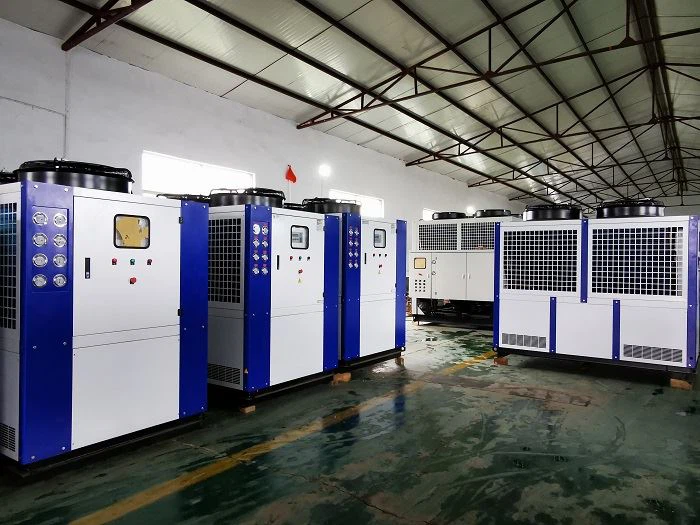
A glycol chiller uses a conventional refrigeration circuit (compressor + ICEMAKE condenser/evaporator package) to cool a glycol–water mixture in an insulated tank. Pumps circulate the glycol to process users (jacketed kettles, plate heat exchangers, AHU/FCU coils, spiral/chill tunnels) and back. Controls maintain a glycol supply temperature instead of “room air,” giving you a steady, product-friendly coolant.
Features & Advantages
• Sanitation: Fewer cold surfaces and pans inside food zones; smooth piping you can clean around.
• Stability: A thermal buffer tank + smart control smooths load spikes.
• Serviceability: Plant-area equipment is easier to access without halting production.
• Scalability: Add taps/users later; increase pump flow or storage capacity in stages.
• Versatility: One loop can serve multiple users (plate coolers, jackets, AHUs), each with a control valve.
Nepal Use-Cases / Sectors
• Dairy: Raw milk pre-cool, pasteurizer downstream cooling, jacketed product tanks.
• Meat & poultry: Chilled water or glycol for carcass/parts cooling steps, AHUs for prep/pack rooms.
• Central kitchens: Jacketed kettles, sauce cool-down, AHU coils in prep areas.
• Beverage & confectionery: Fermentation/tempering jackets; room coils for low-dew-point control.
Operations & Best Practices
• Fluid selection: Choose food-zone-appropriate glycol concentration for your lowest setpoint (freeze margin) and viscosity.
• Tank & buffer: Size the tank to ride through short peaks; insulate lines to avoid sweating.
• Pumps & balancing: Use VFDs where useful; balance branches so distant users still see design flow.
• Control valves: 2-way/3-way valves at users; avoid hunting with realistic control bands.
• Plate heat exchangers: Plan for CIP or easy offline cleaning; gasket/kettle SOPs keep pressure drops predictable.
• Air units (AHU/FCU): Keep returns clear; mark “no-stack” zones; schedule coil hygiene.
• Power hygiene: Stabilizers, phase protection, earthing; small UPS for controller/logger.
• Monitoring: Log glycol supply/return and key user outlet temperatures; duration-filter alarms so people aren’t spammed.
Compliance & Quality
Secondary systems simplify HACCP-style sanitation and align with DFTQC expectations for hygienic handling and records. ISO 22000-style documentation becomes easier: shorter logs, fewer in-room components, clearer corrective actions.
Sustainability / Energy Considerations
• A tight envelope/insulation and insulated piping lower runtime.
• Realistic setpoints (not “extra cold”) prevent hunting and deep defrosts.
• Clean plate exchangers, strainers, and condenser fins shorten cycles.
• Pump VFDs trim power at low load; monitoring reveals habits to optimize.
Benefits / Outcomes (qualitative)
Calmer cooling during peaks; smoother sanitation; fewer line stoppages for service; easier future expansion; more credible records.
Implementation with RM Agrotech × ICEMAKE
• Design: Load study, users list, lowest setpoint, glycol selection, tank & pump sizing, pipe routing.
• Supply & install: ICEMAKE chiller package, insulated tank, pumps, manifolds, control valves, instruments.
• Commissioning: Leak test, flushing, charge & setpoints; controller on UPS; alarm filters & recipients.
• Training: Bilingual SOPs for sampling, top-ups, strainers, plate cleaning, alarm response.
• Service: Spares kit, seasonal checks, early-life reviews.
Checklist
• Define lowest process setpoint and users (kettles, plates, AHUs).
• Select glycol type/concentration; size insulated tank and pumps.
• Route insulated supply/return; include strainers and balance valves.
• Specify control valves and instruments at users.
• Protect power; add UPS for controllers; set alarm duration filters.
• Post SOPs (Nepali/English) for sanitation, fluid checks, and logs.
Call to Action
Considering a cleaner, steadier way to cool? Engage RM Agrotech (authorized ICEMAKE partner in Nepal) to design and commission a glycol/secondary system that keeps production calm and sanitation simple.
FAQ
Q1. Do we need food-grade glycol?
Use an appropriate inhibitor package and concentration for your application; we’ll specify based on temperature and hygiene needs.
Q2. Will pumps add a lot of power use?
Properly sized pumps with VFDs and insulated lines are modest; stability often reduces total runtime elsewhere.
Q3. Can we add users later?
Yes—plan manifolds and spare capacity; expansion is a strength of secondary systems.
Q4. What if power dips mid-batch?
Controllers on a small UPS preserve state; buffer volume gives short ride-through; we test generator transition at handover.
Q5. Is maintenance harder?
It’s simpler: strainers, plate cleaning, glycol checks—done in the plant area, not over product.